The Tower of Babel story stands out in Genesis for its striking portrayal of human ambition and divine intervention. It is a short passage but it carries deep theological weight. The ending of the story not only explains the origin of different languages but also sets a trajectory that echoes throughout the rest of the Bible.
Let’s explore what the Tower of Babel was, how the story ends, and why it matters so much in the wider biblical narrative.
What Was the Tower of Babel?
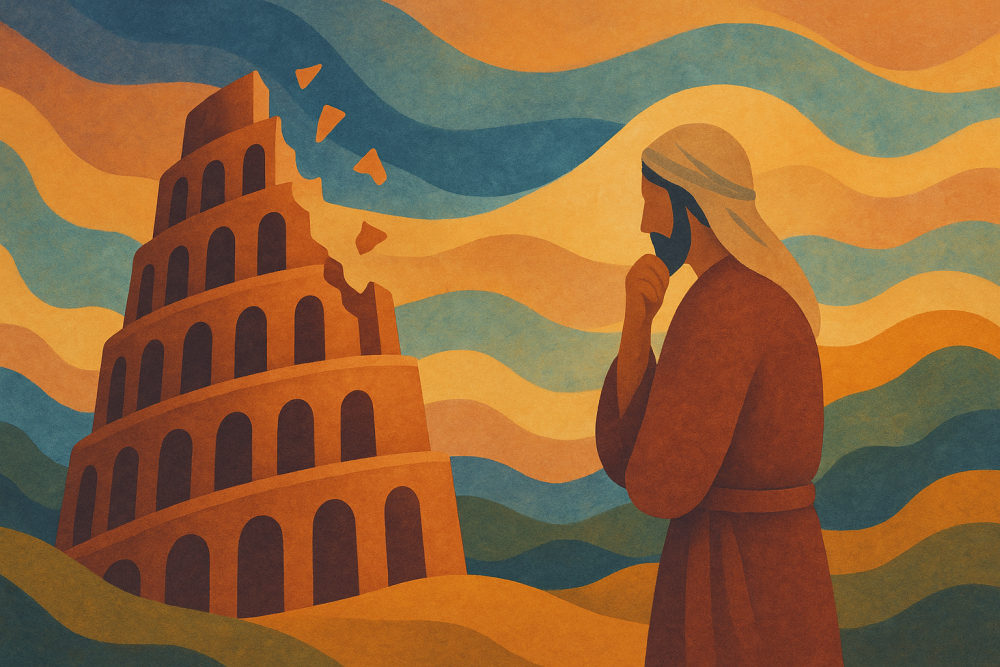
After the flood, humanity began to grow again. Genesis tells us that people settled in the land of Shinar and that “the whole world had one language and a common speech.” United by language and purpose, they decided to build a city with a tower “that reaches to the heavens.”
Their stated motivation is revealing:
“Let us make a name for ourselves, otherwise we will be scattered over the face of the whole earth.” (Genesis 11:4)
Genesis 11:4
This was not simply a construction project. It was an attempt to secure identity, safety, and permanence apart from God.
In the ancient world, towers were often religious structures, with the idea of bridging heaven and earth. The Tower of Babel represents humanity’s desire to reach God on its own terms, using human strength, ingenuity, and collective power.
How Did the Tower of Babel Story End?
The turning point of the story comes when God intervenes.
Genesis describes God “coming down” to see the city and the tower. The language is intentional and ironic: even this great tower, meant to reach the heavens, is so small that God must come down to observe it.
God recognizes that human unity, when driven by pride and self-exaltation has the potential to lead humanity further into rebellion. He says that if they continue unchecked, “nothing they plan to do will be impossible for them.”
Rather than destroying the people or the city, God responds in a surprising way:
- He confuses their language
- They can no longer understand one another
- Construction stops
- The people are scattered across the earth
The place is called Babel because there the Lord confused the language of the whole world.
That is how the Tower of Babel story ends: not with fire or collapse, but with confusion, dispersion, and an unfinished tower.
Why Did God Confuse Their Language?
At first glance, God’s action can feel harsh or puzzling. But within the broader biblical context, it is both an act of judgment and mercy.
Earlier in Genesis, God had commanded humanity to “fill the earth.” At Babel, humans intentionally resist that calling. They want to remain centralized, secure, and self-defined. Confusing their language forces them to spread out, fulfilling God’s original intention for humanity.
In this sense, the scattering is corrective rather than purely punitive. God disrupts a path that would have led to deeper self-reliance and collective pride.
How the Tower of Babel Connects to the Rest of the Bible
Abraham
Immediately after the Babel account, Genesis introduces Abraham. Instead of humanity trying to make a name for itself, God promises to make Abraham’s name great. This is a key contrast.
At Babel:
- Humans act upward, trying to reach heaven
- God responds by scattering
With Abraham:
- God initiates the plan
- Blessing flows outward to “all nations”
This shift shows that God’s solution to human pride is not abandonment, but covenant.
Pentecost
Later in the Bible, the Tower of Babel finds a powerful counterpart in the story of Pentecost. Where Babel brought confusion of language, Pentecost brings understanding across languages. People from many nations hear the same message, not because language differences vanish, but because God bridges them.
The Bible moves from:
- One language → many languages (Babel)
- Many languages → one shared message (the gospel)
This does not erase diversity; it redeems it.
What Does the Tower of Babel Story Teach Us?
1. What are we Serving?
Unity itself is not condemned in the Bible. The problem at Babel is why the people were united. Their unity was centred on self-glory – “let us make a name for ourselves” – rather than obedience or worship.
The story challenges us to ask what our projects are ultimately serving: God’s purposes or our own sense of control and significance.
2. God Opposes Pride, Not Humanity
God does not wipe out the builders of Babel. He intervenes in a way that limits harm while allowing humanity to continue. This reveals a consistent biblical pattern: God resists pride, but He remains committed to His creation.
3. Division is Not the End of the Story
Although Babel ends in division and dispersion, the Bible does not leave humanity there. The confusion of languages becomes a backdrop for God’s long-term plan of redemption.
What Is the Meaning of the Tower of Babel Today?
The Tower of Babel story speaks clearly to modern life. We still build “towers” today – systems, identities, technologies, and institutions meant to give us security, significance, and control.
The question the story leaves us with is not about architecture or language, but trust.
- Where do we look for our sense of worth?
- Are we trying to reach God on our own terms?
- Are we resisting being “scattered” into the wider purposes God has for us?
Babel reminds us that God is not impressed by height, scale, or human achievement. He is concerned with the posture of the heart.