Introduction to Joseph
Joseph is one of the most well-known figures in the book of Genesis, and his story stretches across several chapters. He was one of the twelve sons of Jacob (also called Israel), who lived in the land of Canaan. Joseph’s story is significant not just for what happened to him personally, but because it connects the family history of the Israelites with the nation of Egypt, leading to later events in the Bible’s narrative.
He is introduced as the favored son, and his life forms a bridge between the patriarchs Abraham, Isaac, Jacob, and the formation of the Israelite people in Egypt.
Joseph’s Early Life and Family Challenges
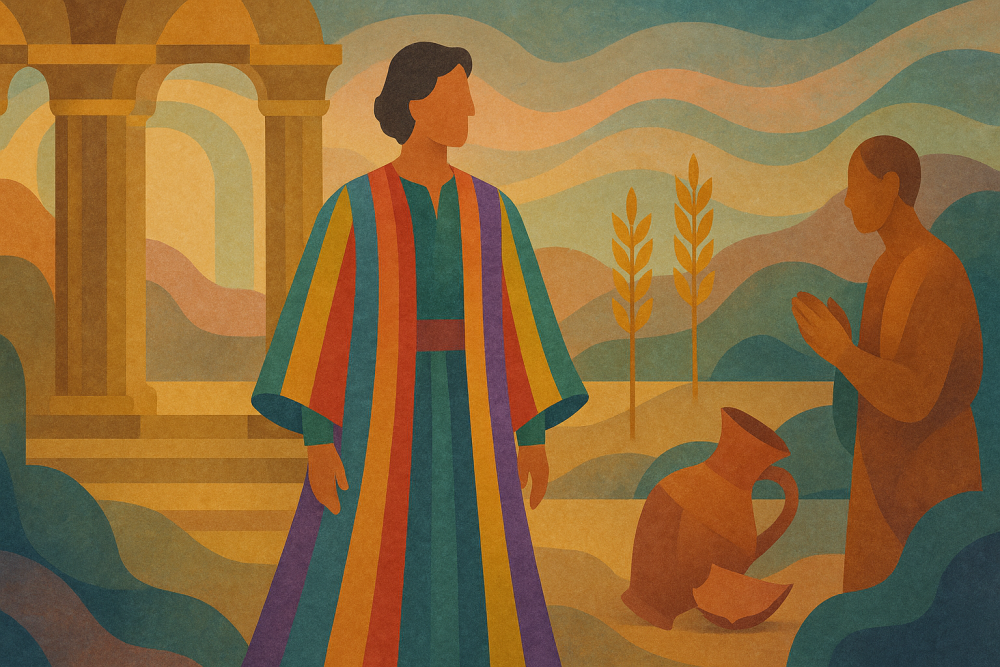
Joseph grew up in a complicated family. His father Jacob favored him, even giving him a special coat of many colors, which set him apart from his brothers. This favoritism caused deep jealousy among his siblings.
Now Israel loved Joseph more than all his children, because he was the son of his old age, and he made him a coat of many colors. His brothers saw that their father loved him more than all his brothers, and they hated him, and couldn’t speak peaceably to him. (Genesis 37:3-4 WEB)
Genesis 37:3-4 WEB
Joseph also had dreams that suggested a future where he would rise above his brothers and parents, which he shared openly. These dreams only increased the tension:
He said to them, “Please hear this dream which I have dreamed: for behold, we were binding sheaves in the field, and behold, my sheaf arose and also stood upright; and behold, your sheaves came around, and bowed down to my sheaf.” (Genesis 37:6-7 WEB)
Genesis 37:6-7 WEB
Rather than humbling his brothers, these revelations made them even more resentful. Eventually, their jealousy pushed them to a breaking point. Joseph was sent by his father to check on his brothers, but when he found them, they plotted against him. Instead of killing Joseph, they sold him into slavery to merchants bound for Egypt, deceiving their father into thinking Joseph was dead.
Midianites who were merchants passed by, and they drew and lifted up Joseph out of the pit, and sold Joseph to the Ishmaelites for twenty pieces of silver. They brought Joseph into Egypt. (Genesis 37:28 WEB)
Genesis 37:28 WEB
Joseph’s Rise to Power in Egypt
Joseph’s new life in Egypt started at the bottom, but his story is marked by persistent faithfulness even in hardship. Joseph was sold to Potiphar, an Egyptian official, and demonstrated wisdom and integrity in his service.
Yahweh was with Joseph, and he was a prosperous man. He was in the house of his master the Egyptian. His master saw that Yahweh was with him, and that Yahweh made all that he did prosper in his hand. (Genesis 39:2-3 WEB)
Genesis 39:2-3 WEB
Despite doing well, Joseph was falsely accused by Potiphar’s wife when he refused her advances. He chose integrity over self-protection:
How then can I do this great wickedness, and sin against God? (Genesis 39:9 WEB)
Genesis 39:9 WEB
As a result, Joseph was thrown into prison. Yet even there, God’s favor was evident:
But Yahweh was with Joseph, and showed kindness to him, and gave him favor in the sight of the keeper of the prison. (Genesis 39:21 WEB)
Genesis 39:21 WEB
Joseph’s ability to interpret dreams eventually brought him before Pharaoh. Interpreting Pharaoh’s troubling dreams, Joseph explained that Egypt would have seven plentiful years followed by seven years of severe famine. He offered practical advice on food storage, and Pharaoh put Joseph in charge of all Egypt:
Pharaoh said to Joseph, “Behold, I have set you over all the land of Egypt.” (Genesis 41:41 WEB)
Genesis 41:41 WEB
Joseph’s Role in Saving His Family and Nations
When the predicted famine arrived, Joseph’s wise management saved not only Egypt but neighboring nations. The crisis drew his brothers to Egypt seeking food, not realizing the ruler before them was the brother they had sold years before. These encounters were rich with emotion, especially as Joseph reunited with his younger brother Benjamin:
He lifted up his eyes, and saw Benjamin, his brother, his mother’s son, and said, “Is this your youngest brother, of whom you spoke to me?” He said, “God be gracious to you, my son.” Joseph hurried, for his heart yearned over his brother; and he sought a place to weep. He entered into his room, and wept there. (Genesis 43:29-30 WEB)
Genesis 43:29-30 WEB
Eventually, Joseph revealed his identity. Rather than seeking revenge, he forgave his brothers, recognizing God’s greater purpose:
Now don’t be grieved, nor angry with yourselves, that you sold me here, for God sent me before you to preserve life. (Genesis 45:5 WEB)
Genesis 45:5 WEB
He brought his entire family to Egypt, ensuring their survival during the remaining years of famine. Joseph’s forgiveness and practical care are seen again at the end of Genesis when his brothers feared he might now retaliate:
As for you, you meant evil against me, but God meant it for good, to bring to pass, as it is today, to save many people alive. Now therefore don’t be afraid. I will nourish you and your little ones.” He comforted them, and spoke kindly to them. (Genesis 50:20-21 WEB)
Genesis 50:20-21 WEB
Theological and Practical Lessons from Joseph’s Story
God’s Sovereignty in Hardship
Joseph’s story repeatedly points to God’s active presence, even in suffering. What looked like disaster-betrayal, false accusation, years in prison-became the very path God used to save many lives. Joseph’s words remind us:
So now it wasn’t you who sent me here, but God, and he has made me a father to Pharaoh, lord of all his house, and ruler over all the land of Egypt. (Genesis 45:8 WEB)
Genesis 45:8 WEB
The Power of Forgiveness
Joseph offers a powerful example of forgiveness. He does not ignore the wrong but chooses kindness and reconciliation, letting go of bitterness for the sake of family and future generations.
Trusting God’s Plan Despite Setbacks
Joseph did not know how his story would turn out. Yet he acted with integrity at each step, trusting God’s presence before the full picture emerged. His life encourages us to be faithful and patient when our own stories do not seem to make sense.
Conclusion: Why Joseph’s Story Remains Relevant
Joseph’s journey with its sharp twists-from beloved son, to slave, prisoner, and finally ruler-illustrates that circumstances can change, but God’s presence and purpose remain. For anyone facing hardship, betrayal, or uncertainty, Joseph’s life offers hope and a model of gracious faithfulness in adversity. The story challenges us toward integrity, forgiveness, and confidence that God can use even the hardest chapters of our lives for good.
- Trust God’s guidance even when the road is difficult.
- Practice forgiveness, even when deeply wronged.
- Watch for God’s purposes in every season, especially the unexpected ones.