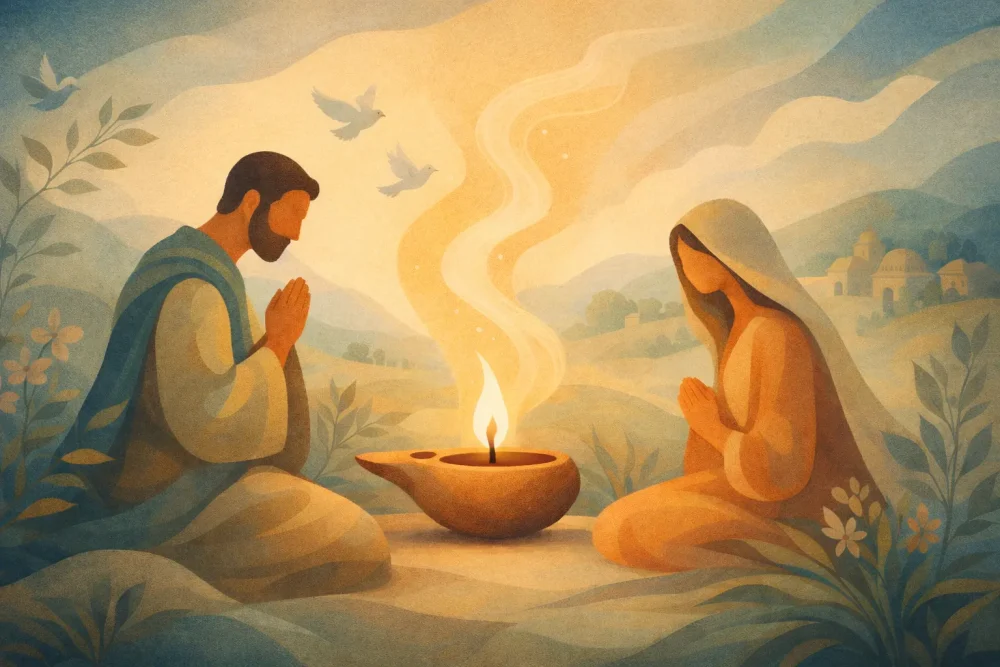
Prayer is at the heart of the Christian life. It’s how we partner with God, how our own will begins to align with his, how we offer our flaws to something higher. Sharing our thoughts, needs and gratitude, while also listening for His guidance.
The Bible is full of examples and teachings about prayer, giving us a clear picture of what it looks like to use it to connect with God. I want to explore what prayer is according to Scripture, look at different types of prayer found in the Bible, address some common misconceptions and see how biblical prayer can shape our daily lives.
What Is Prayer in the Bible?
At its core prayer is simply a conversation with and a looking upwards towards God – an ongoing dialogue between us and our Creator. It’s an amazing and mysterious privilege.
Whether we’re whispering a thank you, reciting liturgy, or pouring out our hearts in a time of need, prayer is how we draw nearer to God.
Prayer isn’t a magical formula or just reciting words; it’s personal communication with a God who listens. In the Bible, prayer is portrayed as a genuine conversation. When we pray, we speak to God honestly about what’s on our heart, and we also learn to listen and be attentive to Him.
One of the earliest hints of prayer in the Bible is people calling upon the name of the Lord in Genesis.
“And call ye on the name of your gods, and I will call on the name of the LORD” (Genesis 4:26)
Genesis 4:26
The Psalms (what is often considered the Bible’s prayer book) are filled with honest prayers expressing every emotion from delight to despair. These examples show that prayer can be raw and real.
Far from requiring fancy language, biblical prayers often sound like a child talking to their father – sometimes with praise and thanks, other times with questions or cries for help. In fact in the Lord’s Prayer, Jesus taught us to address God as “Our Father” (Matthew 6:9).
One of the shortest prayers in Scripture was simply:
“God, have mercy on me, a sinner” (Luke 18:13)
Luke 18:13
Prayer is not about getting the words right, it is about authenticly connecting with God from the heart.
Examples of Prayer in the Bible
The Bible doesn’t just tell us about prayer; it also shows us through stories and examples. Seeing how people prayed in Scripture can teach us a lot about how we can pray today. Here are a few powerful examples of prayer in the Bible, and how they can shape our everyday personal prayer:
Hannah
In 1 Samuel 1, a woman named Hannah pours out her heart to God, weeping and praying for a child. She doesn’t hold back her pain or desperation but speaks to God with raw honesty. God hears Hannah’s prayer and grants her a son. Hannah’s story shows us that we can bring our deepest desires and struggles to God in prayer, without pretending everything is okay. Like Hannah, we’re invited to pray honestly, knowing God cares about our hurts and hopes.
David’s Psalms
King David wrote many of the Psalms, which are essentially prayers set to music. In the Psalms, David prays when he’s joyful, thankful, fearful, and even when he’s angry or despairing. For example, when David felt guilty over his mistakes, he prayed a prayer of confession and repentance (see Psalm 51). When he was overjoyed, he offered prayers of praise (Psalm 103 is a great example). When he was scared or sad, he voiced those feelings too (Psalm 13 begins with lament and ends with renewed trust). David’s prayers teach us that we can tell God everything: the good, the bad, and the ugly. We don’t have to censor our emotions in prayer.
Job’s Wrestling
The book of Job shows that we can bring our hardest questions and complaints to God in prayer. Job at times protested his suffering directly to God, yet God was not angry at Job’s honesty. In fact, God ultimately affirmed Job for coming to Him with raw emotion, saying that “the right way to process through these issues is through the struggle of prayer”.
Job’s story assures us that God welcomes even our messy, painful prayers, and that pouring out our confusion to God is an act of faith, not something to be ashamed of.
Daniel’s Consistent Prayer
Daniel, taken captive in Babylon, made a habit of praying to God three times a day, every day. Even when a law threatened death for anyone who prayed to the Jewish God, Daniel continued his routine of prayer.
Daniel’s example highlights faithfulness in prayer, making prayer a regular part of life. His story encourages us to set aside intentional time to pray and developing a rhythm of talking with God each day. Consistency in prayer helped Daniel stay grounded in a foreign, challenging environment, and it can do the same for us.
Jesus’ Example
No one models prayer better than Jesus himself. Jesus often slipped away from crowds to pray in quiet places.
But Jesus often withdrew to lonely places and prayed (Luke 5:16).
Luke 5:16
He sometimes prayed all night before big decisions.
Jesus went out to a mountainside to pray, and spent the night praying to God. (Luke 6:12)
Luke 6:12
And He prayed with deep emotion – even sweating drops of blood in the Garden of Gethsemane as he surrendered to God’s will
And being in anguish, he prayed more earnestly, and his sweat was like drops of blood falling to the ground. (Luke 22:44).
Luke 22:44
From these examples (and many others), we see that biblical prayer isn’t a one-size-fits-all formula. Moses prayed in frustration for his people. Mary, the mother of Jesus, prayed a beautiful song of praise (Luke 1:46-55). The early Christians prayed together for boldness and saw God move powerfully (Acts 4:23-31). Whether someone prayed kneeling silently (like Hannah) or dancing and shouting (like David bringing the ark to Jerusalem), God responded not to their posture or poetry but to their faith and sincerity.
Also read: How to Understand Scripture: Interpreting Bible Verses
Why is Prayer Important?
Pray without Ceasing
So why does prayer matter so much? For one, the Bible commands and encourages us to pray continually. The Apostle Paul advised believers:
“Rejoice always, pray without ceasing, give thanks in all circumstances; for this is the will of God in Christ Jesus for you.” (1 Thessalonians 5:16-18)
1 Thessalonians 5:16-18
“Do not be anxious about anything, but in everything by prayer and supplication with thanksgiving let your requests be made known to God. 7 And the peace of God, which surpasses all understanding, will guard your hearts and your minds in Christ Jesus.” (Philippians 4:6-7)
Philippians 4:6-7
The Bible verses above give a beautiful snapshot of prayer’s simplicity and scope. It encourages us to bring everything to God in prayer: our needs (supplication), our gratitude (thanksgiving), and all our requests, instead of worrying.
Prayer is the open line of communication where we trade anxiety for trust in God.
To “pray without ceasing” doesn’t mean we must be on our knees 24/7. Instead, it means living in a continual attitude of prayer, staying connected with God throughout the day. In simple terms, prayer is a lifestyle of communication with God.
Growing Closer to Jesus
Prayer is also how we grow closer in our relationship with God. Just as regular communication strengthens a friendship, regularly talking and listening to God strengthens our faith. The more we pray, the more we become aware of God’s presence and work in our lives.
The Bible teaches that God is near to us when we pray sincerely:
“The Lord is near to all who call on him, to all who call on him in truth.” (Psalm 145:18).
Psalm 145:18
It’s comforting to know that whenever we pray genuinely, God draws near.
Prayer in Jesus’ Life
We also see the importance of prayer in Jesus’ life! Jesus himself prayed often and consistently, setting an example for us. The Gospels note that:
“Jesus often withdrew to lonely places and prayed.” (Luke 5:16).
Luke 5:16
The Son of God, who had all power, still made prayer a priority. He prayed early in the morning (Mark 1:35), before big decisions (Luke 6:12), and even during moments of anguish (Luke 22:41-44). If Jesus needed prayer, how much more do we?
Prayer Works
Above all, prayer matters because God hears and responds. The Bible is full of stories of prayers that changed situations – Hannah’s heartfelt prayer was answered with the birth of her son Samuel, Elijah’s prayers brought rain after drought, and the early church’s prayers led to miraculous breakthroughs. While God may not always answer in the way or timing we expect, He does answer – whether it’s with a “yes,” “no,” or “wait.” Through prayer, we partner with God, seeking His will and trusting His power.
Types of Prayer in the Bible
One beautiful thing about biblical prayer is that it’s not one-size-fits-all. People prayed in many different ways and for many different reasons. In fact, the Bible uses several words to describe prayer.
“supplications, prayers, intercessions, and thanksgivings be made for all people” (1 Timothy 2:1)
1 Timothy 2:1
Prayer has a variety of forms. Here are some of the key different types of prayer we see in Scripture.
Praise and Adoration
These prayers focus on who God is. They aren’t asking for anything, just honouring God’s character. This is so important. Many of the Psalms are filled with adoration. For instance:
“Yours, O Lord, is the greatness and the power and the glory and the majesty” (1 Chronicles 29:11)
1 Chronicles 29:11
This is a prayer of praise. When we praise, we acknowledge God’s greatness, love, and holiness in prayer. Jesus taught us to begin our prayers by honouring God’s name.
“Hallowed be Your name” (Matthew 6:9)
Matthew 6:9
It is in these prayers we begin to see perspective in our own lives, grow in trust in his power and goodness and through it we grow in peace and joy. It is in praise and adoration that we sit humbly before the throne, we can then offer up our flaws and desires to something higher and begin honest self-examination.
Thanksgiving
These are prayers that express gratitude for what God has done. The Bible encourages us to give thanks when we pray. Paul writes that we should:
“bring every situation to God through prayer, petition, and thanksgiving” (Philippians 4:6)
Philippians 4:6
Reminding us to recall God’s blessings and say thank you. An example of a thanksgiving prayer is in the Psalms:
“I will give thanks to the Lord with my whole heart; I will recount all of your wonderful deeds.” (Psalm 9:1).
Psalm 9:1
Incorporating gratitude in prayer helps us remember God’s faithfulness and goodness and what he has done in our lives. Again it also allows us to sit humbly and remain dependent on Him.
Even when presenting requests, we are told to do it “with thanksgiving” (as Philippians 4:6 above showed). Gratitude is a powerful part of prayer that cultivates joy and trust in our hearts.
Confession and Repentance
At times, prayer in the Bible involves admitting sins and asking for forgiveness. King David’s prayer in Psalm 51 is a classic example – after he had sinned, he prayed:
“Create in me a clean heart, O God, and renew a right spirit within me.” (Psalm 51:10).
Psalm 51:10
Confessional prayers are honest about our failures and ask for God’s mercy. The promise is that
“if we confess our sins, [God] is faithful and just to forgive us” (1 John 1:9).
1 John 1:9
Praying with a repentant heart restores our fellowship with God. It is when we offer up our flaws so we can align our will with his and bring his direction in our lives.
Petition (Supplication)
This means asking God for our needs and desires. God welcomes us to make requests in prayer.
“Give us this day our daily bread” (Matthew 6:11)
Matthew 6:11
is a petition for daily needs in the Lord’s Prayer. We see many personal requests in Scripture, from Hannah asking for a child to Paul asking for God to remove his “thorn in the flesh.”
Whether it’s provision, guidance, or help in a tough situation, bringing our needs and desires to God is a key aspect of prayer.
Intercession
These are prayers on behalf of others. Instead of praying for my needs, I pray for yours. The Bible has many intercessory prayers. For example, Moses interceded for the Israelites when they sinned, asking God to spare them; Jesus interceded for His disciples (and for us) in John 17; and we’re instructed to pray for “all people,” including our friends, leaders and even especially our enemies.
One New Testament verse says to pray “for all people”, and even specifically to make intercession for others. When we pray for friends, family, our nation, or those in need, we are practicing intercession. It’s a way of loving others by lifting them up to God.
Lament
Not all prayers are cheerful or even hopeful in tone – many are raw and full of pain. A lament is a prayer crying out to God in distress, confusion or sorrow. There’s an entire book of the Bible called Lamentations, and one third of all Psalms are laments! Psalm 13 is a good example, where David prays
“How long, LORD? Will you forget me forever? How long will you hide your face from me?” (Psalm 13:1)
Psalm 13:1
In prayers of lament, believers ask honest questions: “Why, God?” or “How long will this difficulty last?” They might express grief, loneliness, or frustration. Importantly, laments are directed to God – even in pain, the person is still talking with God, which shows an underlying trust. These prayers teach us that we can bring our hardest emotions to God; He welcomes us to be real with Him.
It is important to be brutally honest with God, he knows you inside and out. Like in our earthly relationships honesty allows for a stronger relationship. He wants to hear it.
Guidance (and Deliverance)
Many biblical prayers are requests for direction or rescue. For example, King Solomon prayed for wisdom to lead God’s people (1 Kings 3:7-9), essentially asking for guidance. Others, like King Jehoshaphat, prayed for deliverance when facing enemies in battle (2 Chronicles 20:5-12).
When we feel stuck or afraid, we can pray for God’s help and guidance.
“Deliver us from evil” (Matthew 6:13)
Matthew 6:13
In the Lord’s Prayer is a plea for God’s protection and guidance away from harm. The Bible promises that if we need wisdom, we should ask for it and it will be given.
“If any of you lacks wisdom, you should ask God, who gives generously” (James 1:5)
Imprecation (Justice)
This is a less common type, but it appears in some of the Psalms. These are prayers asking God to enact justice against evil. The psalmists sometimes prayed for God to judge the wicked or stop those doing wrong (see Psalms 7, 69). Such prayers come from a desire to see righteousness prevail.
This is understandable and often comes from healthy intentions. However, Jesus gave us a new perspective – He taught us to pray for our enemies’ good rather than cursing them.
“love your enemies and pray for those who persecute you” (Matthew 5:44).
Matthew 5:44
So while the Bible includes cries for justice, it also calls for us to have mercy and love. We can certainly ask God to set things right in the world, while still following Jesus’ command.
As you can see, prayer in the Bible is wonderfully diverse. It can be praise or protest, gratitude or grief, requests or repentance. We too can pray about everything in every stage of our lives. Joy or pain, success or struggle. God is ready to hear it all.
Try reading: 10 Bible Verses About Waiting on God
How Jesus Taught Us to Pray
We can learn a lot about prayer from Jesus. His disciples once asked Him, “Lord, teach us to pray” (Luke 11:1), and in response Jesus gave them a model prayer now famous as The Lord’s Prayer (found in Matthew 6:9-13). Let’s look at some key lessons Jesus taught about prayer:
Pray Sincerely, Not for Show
In Jesus’ time, some religious leaders turned prayer into a public performance, praying loudly on street corners to look pious. Jesus warned against this. He said,
“When you pray, do not be like the hypocrites, for they love to pray standing in the synagogues and on the street corners to be seen by others… But when you pray, go into your room, close the door and pray to your Father who is unseen” (Matthew 6:5-6).
Jesus urged people to reject “hypocritical, performative” prayer habits meant to impress others. Instead, He encouraged real prayer that comes from the heart, driven by love for God and a desire to do His will.
The point is that prayer is not about looking holy; it’s about genuine connection with God. Whether we pray alone in our room or with others, our focus should be on God, not on who’s watching.
The Lord’s Prayer
When Jesus taught the Lord’s Prayer, He was giving a template for the kinds of things we should pray for. It’s not just a prayer to recite (though reciting it is wonderful too), but a model to guide our own prayers.
Jesus’ model prayer includes several elements: honouring God, submission to His will, asking for our daily needs, seeking forgiveness and giving forgiveness, and asking for spiritual protection . Here’s a quick breakdown of the Lord’s Prayer pattern:
Address God as Father
Recognise you’re talking to a loving Father in heaven (“Our Father in heaven…”).
Honour God’s Name
Give reverence to God (“hallowed be Your name”), praising His holiness.
Seek God’s Will
Surrender your desires to God’s purposes (“Your kingdom come, Your will be done”). Prayer is not about getting our way, but aligning with God’s way.
Ask for Daily Needs
“Give us today our daily bread” – we depend on God for provision.
Request and Give Forgiveness
Confess where we’ve fallen short (“forgive us our debts”) and commit to forgiving others (“as we also have forgiven our debtors”). Receiving and extending forgiveness are vital parts of prayer.
Ask for Guidance and Protection
Acknowledge we need God’s help to live right (“lead us not into temptation, but deliver us from evil”).
Jesus provided this structure not to restrict us, but to help us remember the important aspects of prayer. We can pray freely in our own words while still covering these bases – praising God, submitting to Him, asking for what we need, confessing and turning from sin, and seeking His guidance.
Pray with Faith and According to God’s Will
Jesus often emphasised faith in prayer. He said things like
“Whatever you ask in prayer, believe that you have received it, and it will be yours.” (Mark 11:24).
Mark 11:24
Faith is important – we should trust that God is able to answer and care for us. However, faith is not about trying to force God’s hand. The Bible balances this by reminding us that we need to ask according to God’s will.
“This is the confidence we have in approaching God: that if we ask anything according to his will, he hears us.” (1 John 5:14).
1 John 5:14
Jesus Himself modelled this balance in the Garden of Gethsemane. Facing the cross, He prayed,
“Father, if You are willing, take this cup from Me; yet not My will, but Yours be done.” (Luke 22:42).
Luke 22:42
So, Jesus teaches us to pray boldly and with trust, but also with a heart of surrender to God’s better wisdom. We can absolutely ask God for what we desire and believe He can do it. At the same time, we humbly trust that He will answer in the way that’s ultimately best.
Be Persistent in Prayer
Another lesson Jesus taught is to keep praying and not give up. He gave an illustration of a persistent widow who kept asking a judge for justice until she got an answer, to show that we should be persistent with God (Luke 18:1-8).
This doesn’t mean God is reluctant or needs convincing – rather, persistence grows our faith and keeps us connected to God’s timing. Sometimes answers come slowly, and Jesus encourages us not to lose heart. He said,
“Ask, and it will be given to you; seek, and you will find; knock, and it will be opened to you” (Matthew 7:7).
Matthew 7:7
The New Testament was written in Koine Greek, and the verbs ask, seek, and knock here are all in the present imperative tense.
That matters because the present imperative describes an ongoing or continuous action, not a one-off moment.
There’s a sense of continuous action. Don’t stop praying just because the answer isn’t immediate. Trust that God hears you every time and will respond at the right time. Persistent prayer also shows God that we mean business – that we’re serious about our need or our desire to see His will done.
Pray with a Forgiving Heart
Jesus linked prayer with forgiveness. He taught that when we pray, we should forgive others if we have anything against them, so that our relationship with God stays clear.
“And when you stand praying, if you hold anything against anyone, forgive them, so that your Father in heaven may forgive you your sins.” (Mark 11:25)
Mark 11:25
Harbouring bitterness can hinder our prayers. The Lord’s Prayer itself includes “forgive us… as we forgive others.” This means our prayers are more effective when our hearts are free of un-forgiveness. It’s not that we earn God’s forgiveness by forgiving others, but we are aligning ourselves with God’s merciful character. A big part of prayer is allowing God to shape us and that includes letting go of grudges as we come to Him.
Pray in Secret and Together
Jesus highlighted praying in secret (private prayer), but the Bible also shows the value of praying with others. The early Christians:
“they all joined together constantly in prayer” (Acts 1:14)
Acts 1:14
“They devoted themselves to the apostles’ teaching and to fellowship, to the breaking of bread and to prayer.” (Acts 2:42).
Acts 2:42
Both are important. Private prayer builds your personal relationship with God, free from distractions and audience. Group prayer (with family, friends, or church) brings unity, encouragement, and even allows people to challenge each other in their faith.
“if two of you agree on earth about anything they ask, it will be done for them by my Father” (Matthew 18:19)
Matthew 18:19
There’s power in united prayer. So, we should make space for quiet one-on-one time with God, as well as opportunities to pray alongside others.
Conclusion
The Bible’s verses about prayer paint a picture of a God who is personal, compassionate, and powerful – a God who wants us to pray. Through prayer, we get to know God better and see Him at work in our lives. Whether we’re giving thanks for a sunny day or crying out in a midnight crisis, prayer is our lifeline to the Father’s heart. And we pray not because we have all the right words, but because God has made a way for us to draw near to Him.
In your own life, you can follow the examples of biblical prayer: praise God for who He is, thank Him for what He’s done, confess when you stumble, cry out when you’re hurting and ask freely for what you and others need. That’s what prayer looked like in the Bible and it’s what prayer can look like for us today. And as you pray, take heart from one more encouraging promise:
“Then you will call upon Me and come and pray to Me, and I will listen to you.” (Jeremiah 29:12)
Jeremiah 29:12
God hears every prayer. He may not always answer in the way or timing we expect but He always listens and He never turns away a sincere heart. With that confidence, we can approach Him with the same boldness and trust that the heroes of faith did. After all, as the Bible shows, prayer changes things and more importantly, prayer changes us, drawing us closer to God Himself.