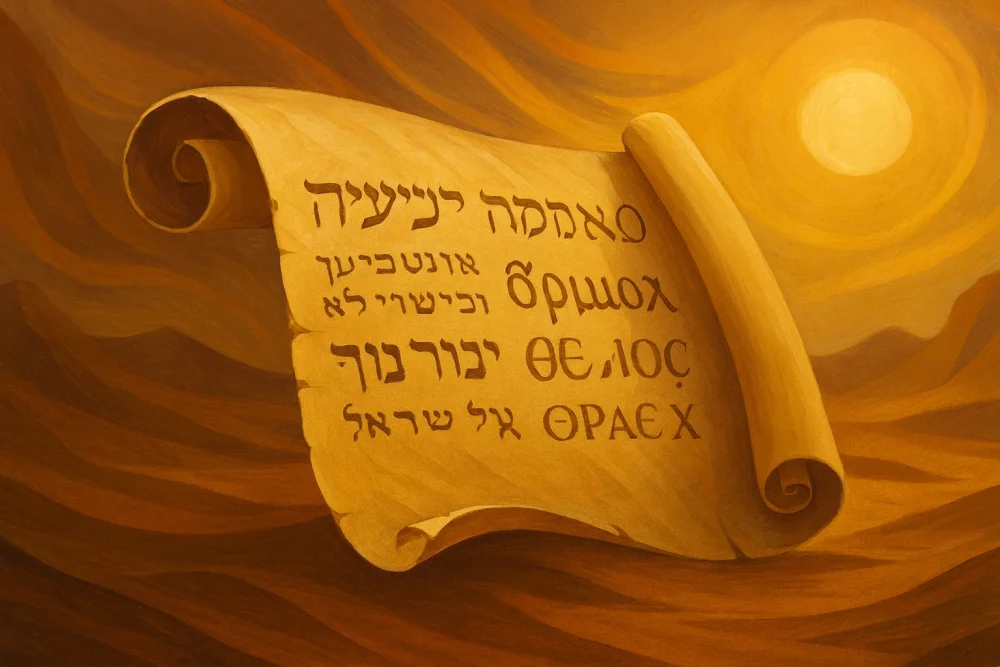
The Bible is a collection of ancient texts and it was not originally written in English. In fact, the Bible was written in three primary languages: Hebrew, Aramaic and Greek. These are the original languages of the Bible’s manuscripts, reflecting the historical and cultural contexts in which the biblical authors lived. Understanding what languages the Bible was written in is important for appreciating its message and how it has been translated and passed down through history.
Also read: How to Understand Scripture: Interpreting Bible Verses
Original Languages of the Bible
Hebrew, Aramaic and Greek are the three languages that make up the original text of the Bible. The Old Testament (the Hebrew Bible) was written mostly in Hebrew, with a few portions in Aramaic. The New Testament was written entirely in Greek (specifically in Koine Greek, the common dialect of the ancient Greek world). Let’s break down these languages and why each was used.
Old Testament (Hebrew)
Primarily Hebrew
The Old Testament was predominantly written in ancient Hebrew, the language of the Israelites. Hebrew is a Semitic language that was used in Israel and Judah and it’s sometimes called the “language of Canaan” or the “Jews’ language” in the Bible itself.
“In that day five cities in Egypt will speak the language of Canaan and swear allegiance to the Lord Almighty. One of them will be called the City of the Sun” (Isaiah 19:18)
Isaiah 19:18
For example, large sections like Genesis, Psalms and Isaiah were composed in Hebrew. Hebrew script was originally written with only consonants! Vowels were added later by scribes to preserve pronunciation.
Some Aramaic
However some parts of the Old Testament were written in Aramaic, a language closely related to Hebrew. Aramaic became common during the later Old Testament period, especially after the Babylonian exile (6th century BC), when Aramaic was the lingua franca of the Persian Empire. As a result, a few portions of the Bible, including sections of Ezra and Daniel, one verse in Jeremiah (Jeremiah 10:11) and a place-name in Genesis (Genesis 31:47) were originally written in Aramaic.
Aramaic uses a script and vocabulary similar to Hebrew but it is a distinct language. This reflects the historical reality that by the time some later Old Testament books were composed, Aramaic was widely spoken among the Jews (for example, in Babylon and Persia) in addition to Hebrew.
New Testament (Greek)
The New Testament was originally written in Greek, specifically in the common Koine Greek of the first-century Mediterranean world. Even though Jesus and his earliest disciples were Jewish and lived in areas where Aramaic and Hebrew were spoken, the decision to write the New Testament in Greek had a strategic purpose.
Origins of Greek
By the time of the first century AD, Greek had become an international language, widely spoken and understood across the Roman Empire – from Judea and Syria to Asia Minor, Egypt, Greece and Rome. This was a result of Alexander the Great’s conquests which spread Greek culture and language far and wide. Koine Greek was the “common” dialect used in everyday life and trade, making it an ideal choice to communicate the gospel message broadly.
Greek was so dominant that even in Rome, educated people knew Greek and the Apostle Paul wrote his letter to the Romans in Greek rather than Latin!
Aramaic in the New Testament
It’s worth mentioning that Aramaic is still found in the New Testament even though the text is Greek. The authors sometimes preserved Aramaic phrases that Jesus spoke, transliterating them into Greek. For example, when Jesus raised a little girl from the dead, the Gospel of Mark records his words in Aramaic:
“Talitha cumi,” which means, “Little girl, I say to you, arise.” (Mark 5:41)
Mark 5:41
And on the cross, Jesus cried out in Aramaic:
“Eloi, Eloi, lema sabachthani?” (which means “My God, my God, why have you forsaken me?”) (Mark 15:34)
Mark 15:34
Such instances show that Aramaic was likely Jesus’ spoken language but the New Testament writers rendered the narrative in Greek, adding translations for those Aramaic words so readers could understand.
Related article: Top 5 Most Accurate Bible Translations
Was the Bible Ever Written in Latin?
A common question is whether the Bible was written in Latin. The answer: not originally. Latin was not one of the original languages of the Bible and none of the biblical books were first composed in Latin. However, Latin plays an important part in Bible history as a later translation.
Origins of the Latin Translation
By the time Christianity spread into the Roman Empire’s western regions (where Latin was spoken, like Italy and Western Europe), there was a need to have the Scriptures in Latin. In the early centuries AD, portions of the Bible were translated from Greek into Latin informally (these are called the Vetus Latina or “Old Latin” versions).
But the most famous Latin translation was done by St. Jerome. In 382–405 AD. Jerome translated the Bible into Latin directly from the original Hebrew and Greek texts. His translation is known as the Latin Vulgate (the word vulgate comes from Latin vulgus meaning “common” tongue). Jerome’s aim was to produce an accurate Latin Bible that the Western church could use and replace the patchwork of old Latin versions which had become inconsistent.
Jerome’s Latin Vulgate became the standard Bible for Western Christianity for over a thousand years! It was considered the authoritative Scripture by the medieval church and so much so that in 1546 the Council of Trent declared the Vulgate the official Latin text of the Scriptures.
For centuries, ordinary people in Western Europe heard the Bible read in Latin at church (even if they didn’t understand Latin). It wasn’t until much later, around the time of the Protestant Reformation that translating the Bible into the common vernacular languages (like German, English, etc.) became more apparent.
What about English Translations?
So behind the Latin text were the original Hebrew and Greek manuscripts which scholars eventually went back to during the Renaissance and Reformation to make new translations, the ones you are likely more familiar with! The King James Version (1611), for example, was created by a team of translators who went back to the original Hebrew and Greek for their work.
Check out: Bible Study Apps for Beginners
Why Does It Matter?
Understanding the languages in which the Bible was written has practical significance for how we read and interpret the Bible today.
Accuracy and Nuance
No translation can perfectly capture every nuance of the original language. Each language has unique words, grammar and idioms.
By knowing that the Bible’s original words were Hebrew, Aramaic, and Greek, we appreciate why different Bible translations sometimes phrase verses differently. Translators are trying to convey meaning from these ancient tongues into our modern language as best and most accurately as they can.
For example, the Hebrew language often uses vivid imagery and wordplay that might not directly carry over into English. Greek has multiple words for concepts like “love” or “word” that English renders with a single word which can hide some nuance.
Cultural Context
The fact that the Bible was written in different languages from specific times and places reminds us that the Bible was written in another time and culture. To interpret it well we should try to bridge the gap between those original cultures and our own. Language reflects culture! When you learn that a Greek word used by a Gospel writer carries a nuance that isn’t obvious in English, you’re uncovering a bit of their cultural mindset.
Strengthening Faith
We can find it reassuring to learn how the Bible was preserved and passed on. The multitude of ancient manuscripts in the original languages is evidence of how widely and carefully Scripture was copied and shared.
For example, we have thousands of New Testament Greek manuscripts, some fragments dating back to within a century of the original writing. Discovery of the Dead Sea Scrolls in the mid 20th century unearthed Hebrew manuscripts of the Old Testament from before the time of Jesus (like the Great Isaiah Scroll, which contains the entire Book of Isaiah in Hebrew from around the 2nd century BC).
This should both humble us and inspire confidence! Humble us because we realise the importance of context and careful study and give us confidence because we see how consistently the core message has survived the journey from Hebrew scrolls and Greek parchment to the book (or app!) in our hands today.
You could also read: Top 5 Most Accurate Bible Translations
Conclusion
Knowing about the Bible’s original languages can enrich your reading of the Scriptures. It highlights the importance of translators and makes you aware of the cultural depth behind your favourite verses.
Ultimately, the miracle is that whether in Hebrew “Bereshit bara Elohim…”, in Greek “En archē ēn ho Logos…”, in Latin “In principio creavit Deus…”, or in English “In the beginning, God created…”, the message comes through: God has spoken to humanity. The Bible’s original languages were the first vehicles of that divine communication, and thanks to translations, we too can hear and understand the unified story that leads to Jesus in our own language today.